

The E.C. Tubb Box Set, Philip Harbottle, Ed. (2015)
Edwin Charles Tubb (1919-2010) was a British SF writer apparently renowned for his “speed and diversity” of production, as well as his copious use--he had nearly 60--of pen names. His prolific output, apparently extending to 140 novels and 230 known shorter works, instantly reminded me of some of the best-known names in current indy-/self-published SFF.
Something else which struck a note with me was this observation, from his bio on Goodreads:
He contributed heavily to Authentic Science Fiction editing the magazine for nearly two years, from February 1956 until it folded in October 1957. During this time, he found it so difficult to find good writers to contribute to the magazine, that he often wrote most of the stories himself under a variety of pseudonyms: one issue of Authentic was written entirely by Tubb, including the letters column.
Ouch. “Publish or perish” clearly isn’t a recent invention. One wonders if this led to his apparent involvement in founding the British Science Fiction Association, perhaps as a pump-priming exercise?
Looking at “ancestral” SF, it’s never quite certain what you’ll get. This collection was a pleasant surprise. None of the stories here were individually particularly exceptional. But as a collection, this was pretty solid entertainment: well worth the time and minimal expense. Although I wouldn’t classify anything I read in this collection as literature it is very clear that Tubb himself was unquestionably literate. And this to a degree which would be exceptional for many authors today.
My favorite from the shorter works: The Ming Vase is a gripping short story of a clairvoyant on the run from the government on the one hand, and his own precognition on the other. (Wait for the surprise twist at the end.) Among the other stories, Survival Demands! offered up an exploration of humanity’s darkest instincts applied on a galactic scale. On the other end of the spectrum, The Bells of Acheron gives a glimpse into an individual’s survival and renewal even as they’re being manipulated. Completing the trip across the emotional spectrum, Last of the Morticians explores with deft, dry humor what happens to those who handle the dead when death has been repealed.
There were two very strong longer works. Child of Space is a novel-length treatment of alien contact on a Lunar base worthy of its own B movie treatment. Under the horror, though, is a glimpse of the stresses and impossible tradeoffs that come with and from being in command. The language is dated and some of the social references were starting to be obsolete by the 1970s. There is a good treatment of the uncertainty about when the novel was written and some of the cringe-inducing references here -- but the story itself and the eternal dilemmas it explores have staying power. According again to Goodreads, Tubb updated a number of his earlier works before his death to make them more appealing to modern readers. This evidently was not one of them, before it was published or republished in 2015/16.
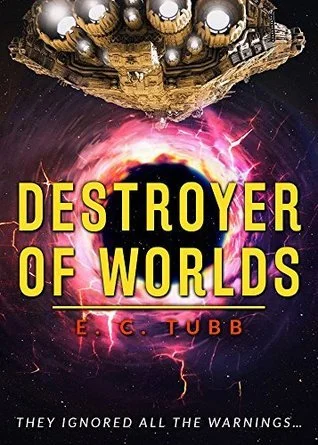
I also appreciated Destroyer of Worlds. This starts, like Child of Space, with a dutiful commander standing guard over his crew. This time, though, peace is interrupted by a mysterious warning which, once disregarded, takes the Ad Astra and its crew into peril of a type they could barely imagine at the hands of an ancient and insidious peril. Some things are not meant to explored. Some warnings are meant to be heeded -- even if it’s more fun to write about them when they’re not. This is a more polished read than Child, and it goes deeper as Tubb exercises his philosophical side in an unusually sophisticated exercise in space opera.
Clearly, Tubb’s body of work bends heavily in the direction of pulp-ishness. As a writer, though, he approached his stories with a degree of deftness and emotional range which were a welcome change from too much contemporary, writing-for-page-count SF. Don’t be mistaken: Tubb could have kept up with the most prolific indie SF authors. While I enjoyed the collection I’m not ready to shell out the $74.10 Amazon wants for the full 33 volume collection of his centerpiece Dumarest Saga.

Take that, modern writing teams!
Still, this retrospective take on a prolific old-school SF writer makes for an interesting comparison with some of today’s mass-produced writing. In between Tubb’s lines I found a reminder a lot of today’s writing can and should aim a little higher even if quantity counts.
Smirk factor: All clear: 2 pts (No smirks given.)
Immersion factor: Shallow water: 1 pt
Writing quality: Above-average: 1.5 pts
Character/plot development: Average: 1 pt
Innovative/interesting: Average: 1 pt
Total: 6.5/10