
• Photo Projects
    • 2019 Photos
    • 2020 Photos
    • 2021 Photos
    • 2022 Photos
  • Home
  • Learning From Others
  • From the Fog
  • Reading Notes
  • About
Menu

Lions In The Fog

SJ Ryan's Blog
  • Photo Projects
  • Archives
    • 2019 Photos
    • 2020 Photos
    • 2021 Photos
    • 2022 Photos
  • Home
  • Learning From Others
  • From the Fog
  • Reading Notes
  • About

No matter how good a lion you are, you can’t see well if you’re surrounded by nothing but fog.

No results found

Featured posts:

Featured
Are We Biased Against Hard Work?
May 31, 2021
Are We Biased Against Hard Work?
May 31, 2021

The naturalness bias may push us away from fairly evaluating people who have had to work hard for success and towards people who seem like “natural” successes — even when we say we value the things the strivers are living.

Read more →
May 31, 2021
GMLordstown.png
August 4, 2020
What Business Are You In?
August 4, 2020

Change is a given in life and work, but we frequently anchor our identity in the past or to things we cannot control. There is a huge difference between being attached to a durable, lasting sense of mission (“what” and “why” we do things) rather than our business models (“how” and “where”). Getting the two confused can have a terrible price.

Read more →
August 4, 2020
Pace Yourself
July 30, 2020
Pace Yourself
July 30, 2020

Ever been told “it’s a marathon, not a sprint?” Most people intuitively understand the suggestion that we should start slow and conserve our energy. Even if you’re someone who only runs when being chased, we can still learn from this.

Read more →
July 30, 2020
obstacles.jpg
July 28, 2020
Falling Off The Path
July 28, 2020

All of us have ambitions, and all of those come with a list of things that need to be done to see them through. But there are always temptations to do things which don’t help advance our cause. We unpack advice on dealing with the real source of our issues.

Read more →
July 28, 2020
July 28, 2020
Advanced Leadership: Trust and Responsibility
July 28, 2020

High-performing organizations choose to empower and trust their employees to do the right thing. They also enforce accountability for those standards. The alternative is to try to micro-manage each individual, which creates oppressive organizational cultures and environments, and eventually saps the employees and the organization of vitality.

Read more →
July 28, 2020
Screenshot from 2020-07-26 15-29-44.png
July 27, 2020
Do We Crawl, Walk or Run?
July 27, 2020

There is plenty of glittering advice that promises to catapult us and our work into the next realm of performance. Before we embrace this advice, we should be sure that we and our organizations are ready for it.

Read more →
July 27, 2020
Koetoezov_kazan cc-by-sa Errabee.jpg
July 15, 2020
Don't Forget Context When Offering Advice
July 15, 2020

The Harvard Business Review article, “Look to Military History for Lessons in Crisis Leadership” offers Covid-era leaders advice drawn from throughout military history. Much of the advice, though, needs more nuance and context to be fully applicable to modern leaders.

Read more →
July 15, 2020
June 29, 2020
And Then What?
June 29, 2020

Slogans capture and channel our dreams. Iteration, adaptation, and the hard work of implementation make them real. Pausing to ask “And then what?” isn’t an admission of defeat. It’s a sign of wisdom and maturity, a willingness to at least start trying to think more deeply about complex and troubling problems.

Read more →
June 29, 2020
netflix slide 80.png
June 23, 2020
Are You Sabotaging Your Own Strategy?
June 23, 2020

Change is in the air. As we enter mid-2020, organizations and populations everywhere are grappling with a series of powerful social, economic and political shocks. There has never been safety in clinging to the status quo, but it is even less of an option now.

Read more →
June 23, 2020
May 21, 2020
When Is It Okay to Quit?
May 21, 2020

It’s said that quitters never win and winners never quit, but is this true? For highly motivated people, the drive to achieve can be a direct line to accomplishment or into a dead end. The key is the ability to discern when our goals no longer suit us. Ironically, this can be hardest for the best-motivated.

Read more →
May 21, 2020

Underdeveloped Organizational Development

June 18, 2023 in Reading Notes, Non-fiction

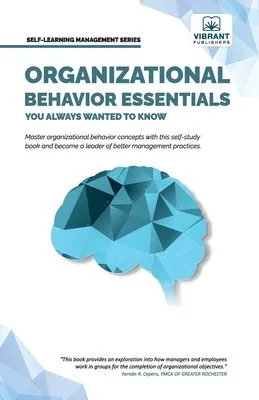
Organizational Behavior Essentials You Always Wanted To Know (Self-Learning Management), Vibrant Publishers, Ankur Mithal. January 2023

Note: This was a NetGalley ARC from this past winter which I duly read, disliked and forgot about after posting an initial review. Amazon wouldn’t accept advance reviews, which was too bad. Rediscovered this while looking for a different book (which I very much did like) and thought I’d post it for the record.

Reading this was a mixed experience. As far as I could tell, Mithal gets very little completely wrong but he brings a very narrow perspective to the book. It is a good catalog of techniques and potential outcomes, but needs reinforcement on a theoretical level.

Up front, there were two very fundamental weaknesses where I do think the author is mistaken and which weaken the volume's credibility:

First, the book assumes (section 2.1) that all organizations are profit-maximizing businesses. ("Enhancement of profit remains the ultimate goal for all organizations," and thus OD interventions fundamentally are about "doing more with less," among other things.) There's no discussion of the differences between for-profit and non-profit or public sector organizations. This was deeply puzzling, because they have very different incentives and dynamics. Focusing on business is a legitimate choice, but that should have been called out explicitly.

Second, in discussing the goals of OD (section 2.1) , we are told the because organizations have specific goals, "All activities carried out [in the organization] are deliberate in nature. They are conducted with a definite goal in mind and are never random." This, I think, is just not true. Any sustained interaction between groups of people is going to produce "emergent" results -- that is, chaotic, random, emotion-driven, bias-ridden, and all of the other gloriously messy things that make us what we are. The challenge is that if you start from rigid rationality as an operating assumption, it's going to add enormous difficulty to getting anything done in an organization.

There was also a certain naivety to the discussion (sections 1.5-1.7) on OD's assumptions, core values and what OD is not. I agree with the very humanistic values the author lays out, but in my experience they're aspirations as much as--or more than--actionable assumptions. (Many of your clients will not care about these things, so what do you do then?) Contra the author, OD has not "always operated with a framework of humanistic and ethical concern for people." Much of the time and motion part of OD, for instance, was about squeezing the most product out of workers -- the shift to a more humanistic approach came after the Second World War, paralleling larger (Western) social changes. And perhaps cynically, the statement in 1.7 that "OD is not about short-term manipulation to achieve immediate financial gains" seems unrealistic in many contexts.

Most of the detailed discussion of interventions and outcomes seems solid, aside from a few quirks. (For example, the author apparently has an unexplained bias against qualitative research, although this often opens up the human experience in organizations in a way quantitative tools can struggle with, although Mithal prefers them 'for the sense of objectivity' they bring--itself a very large, unexamined assumption.) Overall, my impression was that the book deals with an idealized, almost theoretical version of OD and the life of organizations.

And all that's fine in a textbook. As written, this seems like it's more aimed at potential first-time consumers of OD services and I'm not sure how helpful or persuasive it will be for them. I'd have liked to see more time dedicated to how this is supposed to work, not just what one might do. I think that ultimately would have been more convincing and useful.

Nonfiction: 6/10 (3 stars)

Tags: Vibrant, Ankur Mithal, OD
← It's Not Easy Being The Yoruba Nightmare GodNine Dark Horses →
Back to Top

email: sjr@gmx.us
phone: (571) 366-9110